Assemble Your Night Kit
At two in the morning with numb fingertips, complexity is the enemy of wonder. Every gram in a stargazing pack must justify itself through mechanical rigidity, tactile manual controls, and resilience against dew and sub-zero battery drain.
Visual Instruments: Binoculars Before Telescopes
Beginners often rush toward long, shaky department-store telescopes advertised by exaggerated "450x magnification" claims. In astronomy, aperture (front lens or primary mirror diameter) and mount stability govern clarity. A pair of nitrogen-purged 8x42 or 10x50 binoculars delivers an intuitive, upright 5-to-6.5-degree field of view—ten Moon diameters wide—teaching you how to star-hop from Cassiopeia to the Double Cluster or down Orion's Sword before you ever wrestle with inverted finder views.
When stepping up to a telescope, let transport mode dictate optical design. Road-tripping observers with boot space gain unmatched light-gathering per pound from a 150mm or 200mm (6-to-8-inch) Dobsonian reflector resting on a rock-solid wooden rocker box. Air travellers restricted to overhead cabin lockers lean toward a 70mm–80mm ED apochromatic refractor or a compact 102mm–127mm Maksutov-Cassegrain mounted on a heavy-duty carbon travel tripod with a fluid pan/tilt or alt-azimuth head.
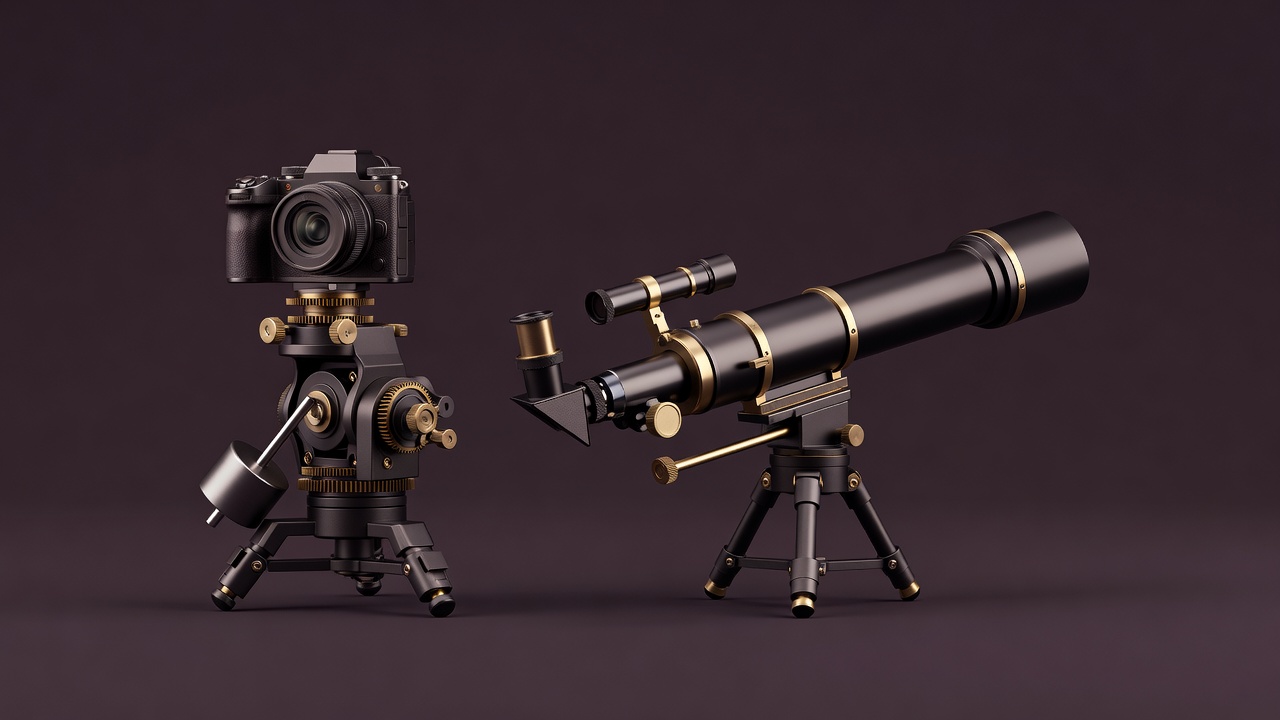
| Configuration | Aperture / Focal Spec | Airline Cabin Fit | Ideal Targets | Key Limitation |
|---|---|---|---|---|
| 10x50 Roof or Porro Binoculars | 50mm / 5mm exit pupil | Personal item | Star clouds, Pleiades, Hyades, Andromeda, bright comets | Slight hand tremor without L-bracket tripod adapter |
| 72mm–80mm ED Travel Refractor | 80mm f/6 doublet/triplet | Carry-on backpack | Lunar terminator, Saturn's rings, Albireo, Orion Nebula | Modest aperture on faint galaxies above mag 10 |
| 127mm Maksutov-Cassegrain | 127mm f/12 folded catadioptric | Carry-on padded cube | High-magnification Moon craters, Jupiter cloud belts, globulars | Narrow field of view; 30-minute thermal cooldown |
| 200mm Dobsonian Reflector | 203mm f/6 Newtonian | Car boot only | Spiral galaxy arms, planetary nebulae, resolved globular cores | Bulky tube; occasional mirror collimation check |
| Full-Frame + 20mm f/1.8 + Tracker | 11.1mm clear entrance pupil | Carry-on camera bag | Milky Way panoramas, emission nebulae, dust lanes | Requires clear view of Polaris or Octans for alignment |
Night Camera Craft: Pinpoint Focus, Exposure Math and Dew
Autofocus hunts helplessly against dark sky. Switch lens and body to manual focus, disable in-body image stabilization when locked onto a tripod, engage live view at 10x magnification on a bright first-magnitude star (such as Vega, Arcturus, Capella, or Canopus), and rock the focus ring millimetres back and forth until the star shrinks to its tiniest point free of magenta or green chromatic halos. Secure the focus ring with a strip of low-residue gaffer tape only if your lens barrel creeps easily, and recheck focus if ambient air drops by more than 8°C during the night, as thermal contraction subtly shifts infinity point.
Old film-era advice known as the "500 Rule" (500 ÷ focal length = max seconds before stars trail) looks smeared on modern 24-to-60-megapixel sensors. Use a conservative 300 Rule in the field—or calculate the sensor-specific NPF Rule factoring pixel pitch, aperture, and target declination—yielding roughly 12 to 15 seconds on a 20mm full-frame lens near the celestial equator.
"Glass radiates heat directly to clear space, chilling below ambient air temperature until invisible condensation fogs your front element mid-timelapse. A 5-volt USB Velcro dew heater strap running off a pocket power bank saves entire nights in coastal and alpine valleys." Thermal & Moisture Control
Unforgiving Small Essentials
- 630nm–660nm Dedicated Red Headlamp: Choose a lamp that turns directly ON in low red mode without cycling through blinding white strobes first.
- Spare Lithium Batteries in Inside Coat Pockets: At −5°C, lithium-ion voltage sags by 35% to 50%; keeping spares against body warmth restores full capacity.
- Closed-Cell Foam Standing Pad: Frozen rock and desert hardpan draw heat rapidly through boot soles during motionless two-hour sessions—far faster than active daytime hiking.
- 2-Second Self-Timer or Intervalometer: Eliminates shutter-press vibration without relying on wireless phone apps that illuminate your face.
Have a specific setup question before travelling? Browse Questions or compose a planning note on Get in Touch.